Intellectual Property (IP) & Copyright Resources
Access these practical resources to better understand your rights & protect your work
Last updated on 8 October 2026
As an independent arts practitioner in Singapore, your creative work is an important part of your livelihood. Understanding copyright can help you protect what you create and make more informed decisions when licensing, collaborating, commissioning or using new technologies.
This page brings together practical resources, including guides and explainers developed by the Intellectual Property Office of Singapore (IPOS), to help you better understand your copyright rights and responsibilities, protect your work, and navigate common copyright issues in your creative practice.
Looking for a quick introduction to AI and copyright? This accessible primer brings together key copyright concepts and issues relating to AI, including those currently being considered in the Public Consultation on AI and Singapore’s Intellectual Property (IP) frameworks.
Use it as a starting point to understand how these issues may relate to your creative practice and learn more about the questions being considered in the Public Consultation.
AI, Copyright & Your Creative Work: Understanding The Law and the Public Consultation Handout [PDF, 7.05 MB] (opens in new tab)
Copyright Fundamentals
In Singapore, copyright protection generally arises automatically once an original work is created and expressed in a tangible form; there is no copyright registration system.
For a quick introduction to the basics, watch this video for a quick overview of copyright fundamentals and Fair Use.

Explore the resources below for practical guidance on creating, protecting and using copyright works.
Copyright at a Glance
Copyright generally protects the expression of ideas, rather than ideas themselves
Protection generally arises automatically when an original work is created — no registration is required
Copyright can apply to a range of creative works, including literary, dramatic, musical and artistic works
The duration of copyright protection varies depending on the type of work and other circumstances
Collaboration vs. Commissioned Works
When works involve multiple people or are made on someone else's behalf, it's worth knowing who actually owns the copyright that arises. The rules work a little differently depending on whether you're collaborating with others or creating under commission, so understanding the distinction early is important.
Key Differences
Joint works | Commissioned works |
|---|---|
|
*For more information, please refer to the section on the “Updated Copyright Act 2021” below. |
Protecting your work
Since copyright protection in Singapore is automatic, it's easy to assume that nothing else needs to be done during the creative process or once the work is complete. But taking a few simple steps to document your work and formalise your agreements can make a big difference if a dispute ever arises.
Key points
Practical Steps | If your work has been infringed |
|---|---|
|
|
Using Others' Work
Best Practices
Always seek permission
Check license terms carefully
Consider Creative Commons options
Document all permissions
Artificial Intelligence (AI) & Copyright
AI tools are increasingly being used across the creative process, raising new questions about copyright — from whether AI-generated or AI-assisted work is protected, to the use of existing works for AI training.
Explore these bite-sized explainers from IPOS to understand what Singapore law currently says, how it may apply to your work, and practical considerations when using AI tools.
Licensing and Dispute Resolution
Licensing allows others to use copyright works while enabling creators and rights owners to set the terms of use and, where applicable, receive payment.
Explore these resources from IPOS to learn more about Collective Management Organisations (CMOs), which manage copyright licensing on behalf of rights owners, and Singapore’s Copyright Tribunals, which can help resolve certain copyright licensing disputes.
Licensing and Dispute Resolution Guides
CMO Class Licensing Scheme Guide (opens in new tab) - Understanding Collective Management Organisations for music, films, and books
Practical Guide to Copyright Tribunals (opens in new tab)- Cost-effective dispute resolution without litigation
Updated Copyright Act 2021
Singapore’s Copyright Act 2021 introduced a number of changes that are relevant to creators, including strengthened rights to be identified as the creator of a work and changes to the ownership of commissioned works.
Explore IPOS’ guides and factsheets on the key changes and what they mean for different types of creators.
Essential Guides and Information
Copyright 101 Infopack [PDF, 606 KB] ↗(opens in new tab) (opens in new tab) - Comprehensive guide covering copyright basics, protection, ownership, and infringement
Copyright Act 2021 Factsheet [PDF, 572 KB] ↗(opens in new tab) (opens in new tab) - Updates on new provisions including commissioned works and moral rights
Targeted Factsheets for Different Creator Types
For Creators and Performers (opens in new tab)- Practical tips on protecting your copyright
For Business Owners (opens in new tab)- Guidelines for commissioning contracts with creators
For Portrait Photography Clients (opens in new tab) - Contract negotiation tips and data protection information
For Creation and Online Distribution of Digital Content (opens in new tab) - Specific issues creators face
IP Support for Enterprises
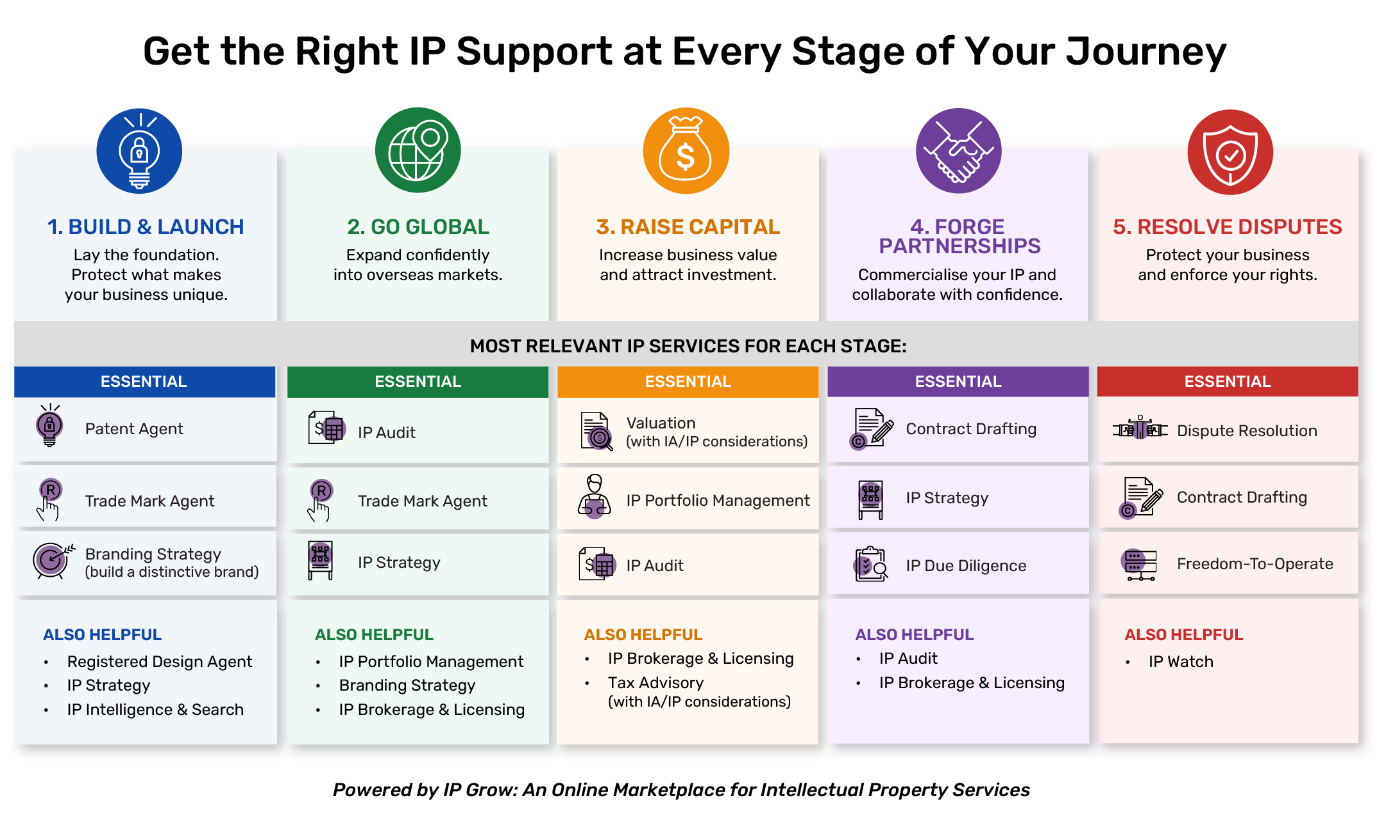
As your practice or creative business grows, you may need different kinds of support to identify, protect, manage or commercialise your intellectual property.
GoBusiness IP Grow (opens in new tab)is a one-stop online platform that helps enterprises identify their IP needs and connect with relevant service providers. Refer to the infographic below to understand the types of IP support that may be relevant at different stages of your business journey.
Selected resources on this page are from the Intellectual Property Office of Singapore (IPOS). Visit the IPOS Copyright Resources (opens in new tab) page for further reading and the latest information.
Note: The information and resources on this page are provided for general reference and do not constitute legal advice. You may wish to seek professional legal advice for guidance specific to your circumstances.